When to Plant Tomatoes
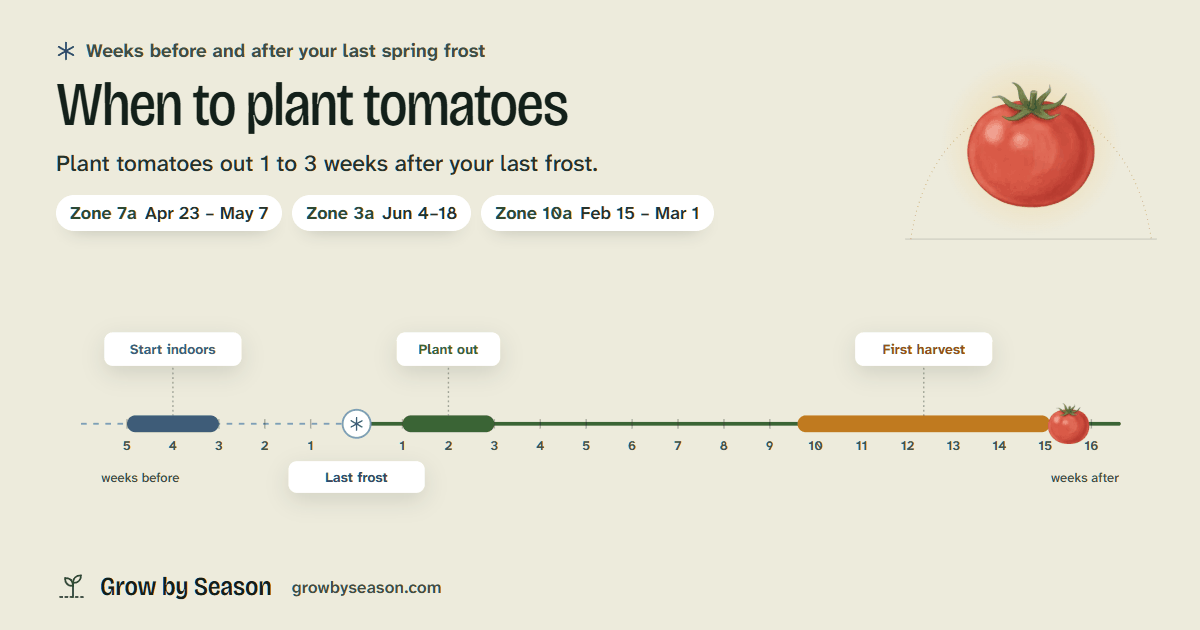
Plant tomatoes out 1 to 3 weeks after your last frost: Apr 23 – May 7 in zone 7a, Jun 4–18 in zone 3a and Feb 15 – Mar 1 in zone 10a. Start the seeds indoors 3 to 5 weeks before your last frost.
Tomatoes at a glance
- Start indoors
- 3 to 5 weeks before your last frost
- Plant out
- 1 to 3 weeks after your last frost
- Time to harvest
- 60 to 85 days from planting out
- Harvest lasts
- about 16 weeks
- Spacing
- 1 plant per square foot
Dates by hardiness zone
Typical dates for each zone; your ZIP code gives your own.
| Zone | Start indoors | Plant out | Harvest | Last day to plant out | |
|---|---|---|---|---|---|
| Zone 3a | Apr 23 – May 7 | Jun 4–18 | Aug 3 – Sep 14 | Jun 18 | |
| Zone 3b | Apr 12–26 | May 24 – Jun 7 | Jul 23 – Sep 25 | Jun 29 | |
| Zone 4a | Apr 7–21 | May 19 – Jun 2 | Jul 18 – Sep 28 | Jul 2 | |
| Zone 4b | Apr 3–17 | May 15–29 | Jul 14 – Oct 1 | Jul 5 | |
| Zone 5a | Mar 29 – Apr 12 | May 10–24 | Jul 9 – Oct 5 | Jul 9 | |
| Zone 5b | Mar 27 – Apr 10 | May 8–22 | Jul 7 – Oct 10 | Jul 14 | |
| Zone 6a | Mar 25 – Apr 8 | May 6–20 | Jul 5 – Oct 16 | Jul 20 | |
| Zone 6b | Mar 19 – Apr 2 | Apr 30 – May 14 | Jun 29 – Oct 19 | Jul 26 | |
| Zone 7a | Mar 12–26 | Apr 23 – May 7 | Jun 22 – Oct 12 | Jul 29 | |
| Zone 7b | Mar 1–15 | Apr 12–26 | Jun 11 – Oct 1 | Aug 5 | |
| Zone 8a | Feb 22 – Mar 8 | Apr 5–19 | Jun 4 – Sep 24 | Aug 11 | |
| Zone 8b | Feb 10–24 | Mar 24 – Apr 7 | May 23 – Sep 12 | Aug 17 | |
| Zone 9a | Jan 26 – Feb 9 | Mar 9–23 | May 8 – Aug 28 | Aug 30 | |
| Zone 9b | Jan 4–18Nights are still cool before mid-February, so this starts a little later. | Feb 15 – Mar 1 | Apr 16 – Aug 6 | Sep 18 | |
| Zone 10a | Jan 4–18 | Feb 15 – Mar 1 | Apr 16 – Aug 6 | Sep 30 | |
| Zones 10b–11b | Frost is rare here, so tomatoes can go in from late winter, and again in late summer for a fall crop. | ||||
Is it too late to plant tomatoes?
The last day to plant out tomatoes is 88 days before your first fall frost.
Late in the season, set out sturdy transplants of an early or cherry variety; they ripen well ahead of big beefsteaks.
How to plant tomatoes
From the seed tray to the first ripe fruit, with the rules extension services give and where each one comes from.
Warm soil and mild nights
Tomatoes go out once the soil is at least 60 °F, measured about 4 inches down early in the morning, when it is coldest. UC Master Gardeners in Contra Costa County note that soil reaches that point only after daytime highs are reliably in the 60s and nights no longer drop below 50 °F. Utah State University Extension gives the same 60 °F soil rule, and adds that tomato flowers do not set fruit on nights below 50 °F.
The dates on this page start a week after the median last frost, which gives the soil time to catch up with the air. A cheap soil thermometer settles it in your own bed. Sandy soil, raised beds and pots warm up sooner than soil in the ground (UC Master Gardeners).
To gain a week or two, lay black plastic or landscape fabric over the bed 2 to 3 weeks before planting (University of Maryland Extension). Hold back straw or grass clippings until the soil has warmed further, to about 75 °F, because organic mulch keeps the soil cool (Utah State).
Starting the seeds indoors
University of Minnesota Extension starts tomato seeds five to six weeks before the plants go outside, and warns that older seedlings are harder to manage without giving an earlier harvest. This site uses six weeks before planting out, the span the extension guides on the seed-starting calendar share, which lands 3 to 5 weeks before your last frost. Some guides count from the frost instead: Clemson starts seeds six to eight weeks before it.
Sow the seeds a quarter inch deep in a sterile, soilless seed mix. A heat mat that holds the tray at 75 to 85 °F speeds them up; once they are up, about 70 °F is right. Give them bright light straight overhead, or the stems stretch and lean. When the first true leaves show, thin or move the seedlings so they stand about 2 inches apart (University of Minnesota).
A good transplant is 6 to 10 inches tall, stocky and dark green, with five to seven leaves (Utah State). Utah State also advises picking off any flowers before planting, since plants set out in flower or fruit establish slowly.
Hardening off
Seedlings raised indoors need about a week to get used to sun and wind (Clemson, Penn State Extension). Start in a sheltered spot with bright, indirect light or a couple of hours of sun, add more each day, and water a little less often without letting the plants wilt. Bring them in if the night is forecast to come close to freezing (University of Minnesota). Purple veins on the leaves are normal at this stage, says Clemson. The seed-starting calendar marks the day to begin, two weeks before planting out.
Planting out, deep and with support
Plant in the late afternoon or on a calm, cloudy day, and water the plants well first (University of Minnesota, Clemson). Put the stake or cage in at planting time; Texas A&M AgriLife stakes right after transplanting to spare the roots.
Tomatoes grow roots along any part of the stem you bury, so plant them deep, with only two or three sets of true leaves above the soil (Clemson). A tall, leggy plant can go in sideways: dig a trench 3 to 4 inches deep, strip the lower leaves and lay the stem along it, so only the top leaves stand above ground (University of Minnesota). The drawing near the top of this guide shows the trench. If the plant grew in a peat pot, bury the rim; an exposed edge wicks water out of the root ball.
Spacing depends on how you support them. Clemson sets plants 24 inches apart in rows 3 feet apart, and NC State Extension 1½ to 2 feet apart with 3 to 4 feet between rows. Wire cages need more room, at least 4 feet apart (University of Maryland). A 6-foot stake goes about a foot into the ground, 4 to 6 inches from the stem, soon after planting (Clemson).
Bush (determinate) kinds stop at about 24 to 30 inches and ripen their crop over four to six weeks, which suits canning and small spaces. Vining (indeterminate) kinds keep growing, often 3 to 5 feet or more, and ripen fruit until the weather turns cold (University of Minnesota).
Water, mulch and feeding
About an inch of rain or irrigation a week is ideal, given as one good soak rather than light sprinkles, and at the base of the plant: wet leaves catch diseases more easily (University of Minnesota). Once fruit is setting, NC State puts the need at about 1½ inches a week. Keep it steady: swings between wet and dry soil bring on blossom-end rot (University of Minnesota).
A 3 to 4 inch layer of straw or untreated grass clippings keeps weeds down (University of Minnesota); put it down once the soil is warm (Utah State). Go easy on nitrogen: too much gives bushy, leafy plants that are slow to bear. Minnesota feeds once, when the first fruits start to grow.
Pruning and tying
As a staked plant grows, tie it loosely to the stake every 12 inches with strips of rag or twine (Texas A&M AgriLife); Clemson ties it at every 10 inches of height. Plants in cages need no ties.
Small shoots called suckers grow where each leaf joins the main stem. On staked plants, Texas A&M removes them by bending them sideways until they snap, and keeps the lowest one if you want a second main vine. Clemson trains staked plants to one or two stems and pinches the suckers off every week. Caged plants need no pruning (Texas A&M), or a single one down to three or four main stems (Clemson): the heavier leaf cover shades the fruit from sunscald.
Tomatoes in containers
Pick a compact variety, with "patio", "balcony" or "bush" in the name, and check the height on the label (Clemson HGIC). In Clemson's words, "a 14-inch to 20-inch container is suitable for most compact cultivars"; a 5-gallon bucket with holes drilled in the bottom works too. Tall vining kinds do poorly in a 12-inch pot. NC State asks for at least a foot of depth and drainage holes.
Set the pot where it gets six hours of sun or more and where you can reach it with a hose: in the height of summer a container tomato needs water every day (Clemson). Add a cage at planting for any variety that grows taller than 2 feet. Potting mix warms up sooner than garden soil in spring, so check a pot's own soil temperature before you plant.
A second planting in warm zones
Where summers are long, a second crop planted in midsummer ripens in fall. Texas A&M AgriLife Extension sets fall tomatoes out about 100 days before the first expected frost. LSU AgCenter transplants them in July, using heat-set varieties bred to set fruit through hot nights (it names Florida 91, Solar Set, Sun Master and Phoenix among them), and warns that insects and diseases are usually worse in fall than in spring. In South Carolina, Clemson gives July 1 to 15 for a fall crop on the Coastal Plain and does not recommend one in the Piedmont.
On this page, "Is it too late to plant tomatoes?" counts back from your own first fall frost and answers for your ZIP code.
Picking and ripening
The first fruit is ready 52 to 90 days after planting out, depending on the variety. Flavor is best when it ripens fully on the vine and is still firm (Clemson). Texas A&M AgriLife also picks at full color, and lets fruit picked pink finish at room temperature.
Keep green fruit out of the refrigerator, which stops it ripening. Clemson ripens it at about 70 °F, and it needs no light to do so. Green tomatoes keep one to three weeks at 50 to 70 °F. Ripe ones last 4 to 7 days at room temperature or in the refrigerator, though the cold can dull the flavor and make them mealy (Clemson).
Common problems
Flowers falling off without fruit is usually the weather. Penn State Extension sees it when nights drop below 55 °F or stay above 75 °F, and Utah State when nights fall below 50 °F or days pass 95 °F. It stops on its own once the weather evens out.
Frost kills tomato plants (Penn State), and cold weather while the first fruit sets leaves it scarred and misshapen, the scar called catfacing (Utah State). After planting out, watch the forecast: University of Maryland Extension throws a quilt over the cage on nights below 30 °F. Your ZIP code's frost odds, in the planting calendar, show how likely a late frost still is.
Blossom-end rot, a dark, leathery patch at the bottom of the fruit, comes from too little calcium reaching it, and it is worst after swings between dry and wet soil (NC State). Even watering helps prevent it. Cracks in ripening fruit follow fast growth after heavy rain in warm weather (University of Minnesota).
Sources, read on October 21, 2026: UC Master Gardeners of Contra Costa County, It's Time to Plant Your Summer Tomato Crop (2025); Utah State University Extension, Tomatoes in the Garden; University of Maryland Extension, Tomatoes; University of Minnesota Extension, Growing tomatoes in home gardens (reviewed 2024); Clemson HGIC 1323, Tomato (revised 2022); Penn State Extension, Tomatoes: From Seedlings to Fruit; Texas A&M AgriLife Extension, Easy Gardening: Tomatoes; NC State Extension, Growing Tomatoes in the Home Garden; Clemson HGIC, Tomatoes in Containers; LSU AgCenter, Summer Vegetable Gardening. How we check.
Growing tomatoes
Tomatoes want six to eight hours of sun, warm soil and steady water. Give each plant a cage or a stake when it goes in, mulch once the soil has warmed, and water at the base to keep the leaves dry. Indeterminate kinds keep growing and fruiting until frost; determinate kinds ripen their crop over a few weeks.

Questions about tomatoes
Why do tomato flowers fall off?
Usually the weather. Flowers drop when late-spring nights are chilly or when summer days turn very hot. Once the weather settles the plants set fruit again, and steady watering helps.
When is a tomato ready to pick?
When it has full color and gives a little to a gentle squeeze. Tomatoes picked at the first blush also ripen well on the kitchen counter, which is handy at the end of the season.
What soil temperature do tomatoes need?
At least 60 °F about 4 inches down, measured early in the morning. Soil usually gets there once daytime highs are reliably in the 60s and nights stay at 50 °F or above.
How deep should I plant tomato transplants?
Deep enough that only two or three sets of true leaves stay above the soil; roots grow from the buried stem. A tall, leggy plant can be laid sideways in a trench 3 to 4 inches deep.
How far apart should tomato plants be?
About 2 feet apart in rows 3 feet apart for staked plants. Plants in wire cages need at least 4 feet between cages.
Should I remove tomato suckers?
On staked plants, yes: snap off the shoots that grow where a leaf joins the main stem, keeping one or two main stems, and tie the plant to its stake every 10 to 12 inches. Plants in cages need little or no pruning.
When are tomatoes ready to pick?
When they reach full color and are still firm: flavor is best when they ripen on the vine. Fruit picked pink or green finishes ripening at room temperature, about 70 °F, out of the refrigerator.
Can I grow tomatoes in a pot?
Yes. Choose a compact patio or bush variety and a 14-inch to 20-inch container, or a 5-gallon bucket with drainage holes, in at least six hours of sun. In midsummer it needs water every day.
 Peppers
 Hot peppers
 Eggplant
 Tomatillos