USDA hardiness zone 3a · 5 ZIP codes
Zone 3a planting calendar
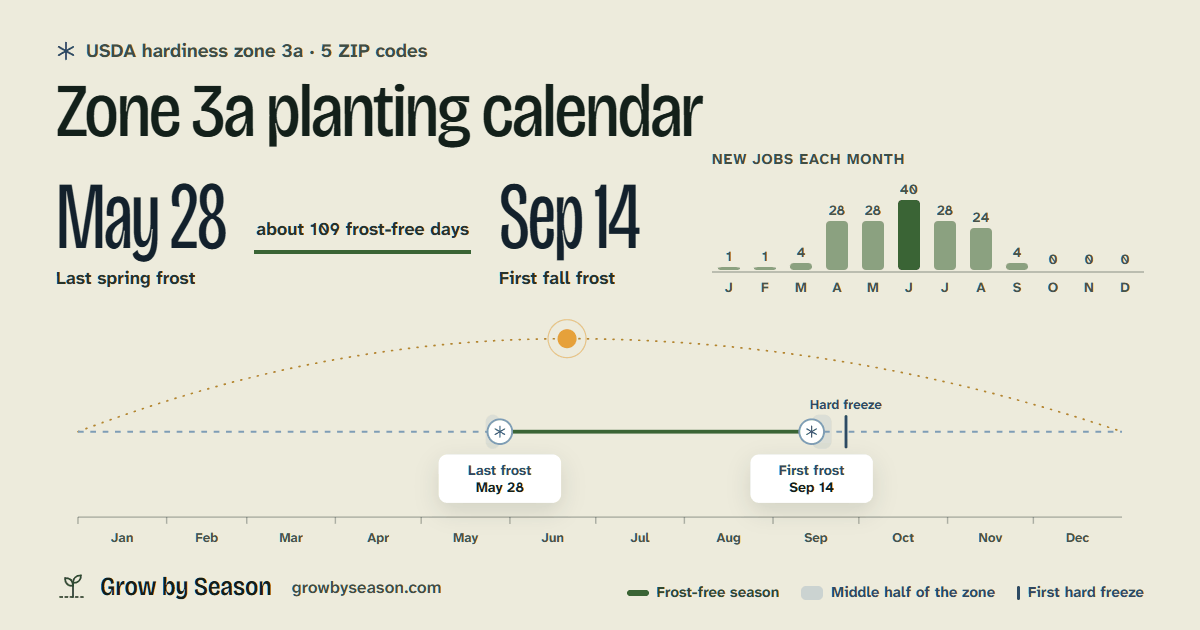
In zone 3a the last spring frost comes around May 28 and the first fall frost around September 14 (median of its 5 ZIP codes): about 109 frost-free days. June is the busiest month, with 40 jobs; here is every month.
Typical frost dates
- Last spring frost
- May 28Around May 28. Middle half of the zone: May 23 – May 28. Over by Jun 16 in 9 of 10 years.
- First fall frost
- Sep 14Around September 14. Middle half of the zone: Sep 14 – Sep 21. After Aug 30 in 9 of 10 years.
- First hard freeze (28 °F)
- Sep 26Around September 26. Last in spring: May 13. At 24 °F: last May 2, first Oct 6.
- Frost-free season
- about109 days
- Coldest winter nights
- -40 to -35 °F
- ZIP codes in the zone
- 5
Most of its weather stations are in Minnesota.
Month by month in zone 3a
Every job for all 63 crops, in the month it starts.
January in zone 3a
1 seed start indoors on Jan 22.
Start indoors
- Leeks Jan 22 – Feb 26
February in zone 3a
1 seed start indoors on Feb 19.
Start indoors
- Onions Feb 19 – Mar 19
March in zone 3a
4 new jobs, Mar 12–26, all seed starts indoors.
April in zone 3a
28 new jobs, Apr 2–30 (15 sowings outside).
Start indoors
- Parsley Apr 2–16
- Cauliflower Apr 2–23
- Peppers Apr 16–30
- Hot peppers Apr 16–30
- Eggplant Apr 16–30
- Basil Apr 16 – May 14
- Tomatoes Apr 23 – May 7
- Marigolds Apr 23 – May 14
- Tomatillos Apr 30 – May 21
Sow outside
- Peas Apr 16 – May 7
- Spinach Apr 16 – May 14
- Kale Apr 16 – May 14
- Arugula Apr 23 – May 21
- Radishes Apr 23 – Jun 4
- Shallots (shallot sets) Apr 30 – May 14
- Collard greens Apr 30 – May 21
- Kohlrabi Apr 30 – May 21
- Turnips Apr 30 – May 21
- Asparagus (asparagus crowns) Apr 30 – May 21
- Rhubarb (rhubarb crowns) Apr 30 – May 21
- Mustard greens Apr 30 – May 28
- Potatoes (seed potatoes) Apr 30 – May 28
- Lettuce Apr 30 – Jun 11
- Green onions Apr 30 – Jun 11
Plant out
- Cabbage Apr 30 – May 14
- Onions Apr 30 – May 14
- Strawberries (strawberry plants) Apr 30 – May 21
Sow for fall
- Brussels sprouts Apr 20 – May 11
May in zone 3a
28 new jobs, May 7–30 (11 plantings out). Last spring frost around May 28.
Sow outside
- Bok choy May 7–28
- Parsnips May 7 – Jun 4
- Carrots May 7 – Jul 6
- Beets May 7 – Jul 13
- Cilantro May 14 – Jun 11
- Swiss chard May 14 – Jun 18
- Dill May 21 – Jun 18
- Sunflowers May 28 – Jun 25
Plant out
Sow for fall
- Cabbage May 18 – Jun 15
- Cauliflower May 25 – Jun 15
- Broccoli May 25 – Jun 22
June in zone 3a
40 new jobs, Jun 4–30 (17 first harvests).
Sow outside
- Zinnias Jun 4–18
- Nasturtiums Jun 4–18
- Cosmos Jun 4–18
- Winter squash Jun 4–25
- Sweet corn Jun 4–25
- Cucumbers Jun 4–29
- Green beans Jun 4–29
- Zucchini Jun 4 – Jul 6
- Watermelons Jun 11–25
- Cantaloupes Jun 11–25
- Okra Jun 11 – Jul 2
Plant out
- Tomatoes Jun 4–18
- Tomatillos Jun 4–18
- Celery Jun 4–18
- Marigolds Jun 4–18
- Peppers Jun 11–25
- Hot peppers Jun 11–25
- Eggplant Jun 11–25
- Basil Jun 11–25
Sow for fall
- Peas Jun 22 – Jul 6
- Kale Jun 22 – Jul 20
- Collard greens Jun 22 – Jul 20
- Green onions Jun 29 – Jul 13
Start picking
- Chives Jun 6 – Oct 26
- Turnips Jun 9 – Jul 20
- Lettuce Jun 9 – Sep 26
- Peas Jun 10 – Jul 16
- Kale Jun 10 – Oct 26
- Mint Jun 13 – Oct 26
- Kohlrabi Jun 14 – Jul 20
- Bok choy Jun 16 – Jul 22
- Collard greens Jun 24 – Oct 26
- Strawberries Jun 25 – Jul 23
- Beets Jun 26 – Sep 11
- Cilantro Jun 28 – Sep 28
- Parsley Jun 28 – Oct 26
- Thyme Jun 28 – Oct 26
- Green onions Jun 29 – Oct 9
- Cabbage Jun 29 – Oct 11
- Dill Jun 30 – Aug 25
July in zone 3a
28 new jobs, Jul 1–31 (19 first harvests).
Sow for fall
Start picking
- Broccoli Jul 1 – Oct 8
- Swiss chard Jul 3 – Sep 28
- Marigolds (in bloom) Jul 4 – Sep 14
- Oregano Jul 5 – Oct 26
- Carrots Jul 6 – Sep 24
- Cauliflower Jul 8 – Sep 28
- Basil Jul 11 – Sep 14
- Potatoes Jul 14 – Sep 25
- Zucchini Jul 19 – Sep 14
- Nasturtiums (in bloom) Jul 19 – Sep 14
- Sage Jul 20 – Oct 26
- Green beans Jul 24 – Sep 4
- Cucumbers Jul 24 – Sep 14
- Lavender Jul 27 – Sep 21
- Rosemary Jul 27 – Sep 28
- Shallots Jul 29 – Sep 1
- Onions Jul 29 – Sep 11
- Garlic Jul 30 – Aug 20
- Okra Jul 31 – Sep 14
August in zone 3a
24 new jobs, Aug 3–31, all first harvests.
Start picking
- Tomatoes Aug 3 – Sep 14
- Zinnias (in bloom) Aug 3 – Sep 14
- Cosmos (in bloom) Aug 3 – Sep 14
- Leeks Aug 5 – Oct 26
- Sunflowers (in bloom) Aug 6 – Sep 14
- Tomatillos Aug 8 – Sep 14
- Sweet corn Aug 8 – Sep 14
- Peppers Aug 10 – Sep 14
- Arugula Aug 12 – Sep 19
- Mustard greens Aug 12 – Sep 24
- Eggplant Aug 15 – Sep 14
- Bok choy Aug 15 – Sep 20
- Spinach Aug 15 – Sep 22
- Turnips Aug 15 – Oct 2
- Peas Aug 16 – Sep 14
- Brussels sprouts Aug 18 – Oct 26
- Hot peppers Aug 20 – Sep 14
- Watermelons Aug 20 – Sep 14
- Cantaloupes Aug 20 – Sep 14
- Kohlrabi Aug 20 – Sep 25
- Radishes Aug 21 – Sep 16
- Winter squash Aug 23 – Sep 14
- Celery Aug 28 – Sep 28
- Parsnips Aug 31 – Oct 26
September in zone 3a
4 new jobs, on Sep 14, all fall sowings and plantings. First fall frost around Sep 14. First hard freeze (28 °F) around Sep 26.
Sow for fall
- Garlic (garlic cloves) Sep 14 – Oct 5
- Tulips (tulip bulbs) Sep 14 – Oct 5
- Daffodils (daffodil bulbs) Sep 14 – Oct 5
- Crocus (crocus corms) Sep 14 – Oct 5
October in zone 3a
Nothing new to start; keep picking what is still growing, then clear finished beds and spread compost.
November in zone 3a
Nothing to sow; clean and store the tools and note what grew well.
December in zone 3a
A month to rest the soil and plan next year.
Starting seeds indoors? The zone 3a seed-starting chart gives each crop's days to sow, pot up, harden off and plant out.
Questions about zone 3a
What can I plant in zone 3a this fall?
After September 1, 4 fall sowings and plantings are still open, all until Oct 5: garlic cloves, tulip bulbs, daffodil bulbs and crocus corms. First frost around Sep 14.
How many frost-free days does zone 3a have?
About 109: May 28 to Sep 14, the median of 5 ZIP codes.
Which perennials survive the winter in zone 3a?
The Missouri Botanical Garden rates 2 of the 10 perennial crops here for zone 3 (-40 to -30 °F): asparagus and rhubarb. Rated only from a warmer zone: chives, oregano, sage and strawberries from zone 4; thyme, mint and lavender from zone 5; rosemary from zone 8. Where winters are colder than a perennial's rating, gardeners often grow it as an annual or keep it in a pot that comes indoors for winter.